
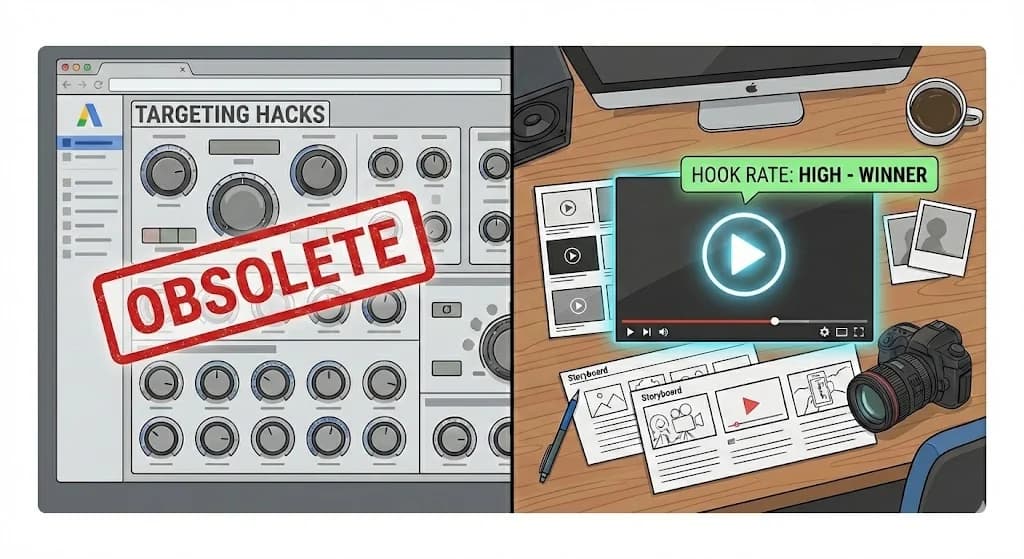
The Algorithm is Not Your Friend: Why Creative Strategy Wins Over Targeting Hacks
For years, media buyers obsessed over "hacks": lookalike audiences of 1%, excluding iOS14 users, dayparting... Those days are over. The AI behind Meta and Google is smarter than any human buyer. Restricting the audience is now restricting performance. The machine needs broad audiences to learn, but it needs one thing from you: superior inputs.
The Creative IS the Targeting
If you want to sell premium dog food, you don't select "Dog Lovers" in the interests anymore. You make a video that clearly calls out "Is your dog a picky eater with sensitive skin?". The algorithm listens to who stops scrolling, who watches 3 seconds, and who clicks. The creative filters the audience for you.
The "Hook-Rate" Framework for High-Performance Ads
We analyze thousands of ads monthly. The winners always follow a psychological structure:
- The Hook (0-3s): Visual disruption. If they don't stop scrolling, you don't exist. Pattern interrupts are key here.
- The Hold (3s-15s): Educational value or entertainment. Why should they care? This is where you agitate the problem.
- The Payoff (CTA): A clear, singular instruction. Don't ask them to "Like and Subscribe and Buy". Just ask them to "Shop Now".
Iterative Testing vs. "Set and Forget"
Creative strategy is not a one-time setup. It's a scientific process. We launch "Creative Sprints" where we test 10 variations of a hook against the same body content. The data tells us which angle resonates. Don't waste time tweaking the age range in Ad Manager. Spend that time scripting better videos. That is the only lever you have left to lower your CPM.
Related Insights
When AI Recommends Tools, Is Yours on the List? The New Digital Positioning Playground
Traditional SEO is changing. We analyze how to structure your web platform and data so that AI models recommend your product.
Read Article →JavaScript Grows Up: Why the ES2026 Specification is a Declaration of War on External Libraries
Ecma International officially approves ECMAScript 2026. We analyze how the language natively absorbs historical challenges in mathematical precision, async streams, and data formatting.
Read Article →