
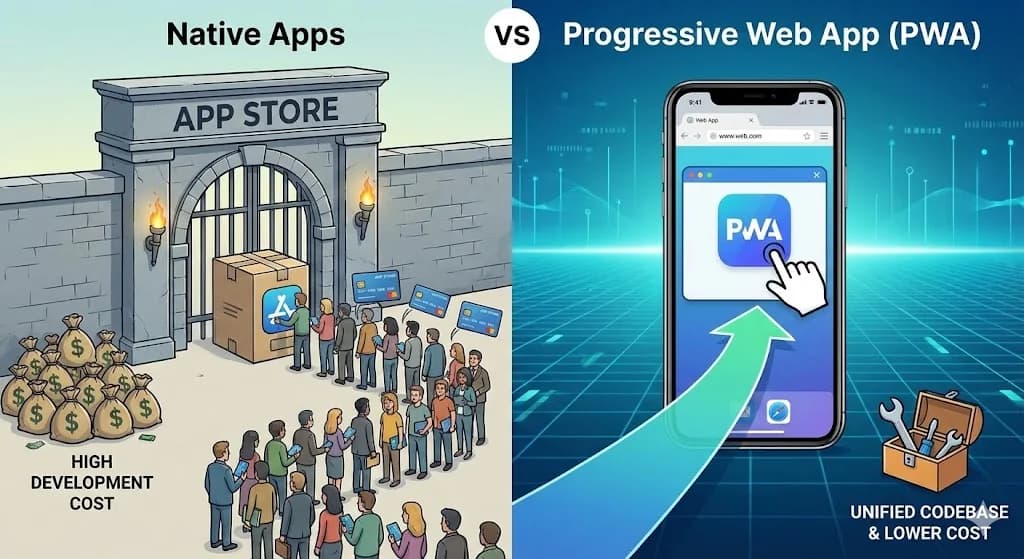
Native Apps vs. PWA: Why Spending €50k on an App Might Be Your Startup's Worst Mistake
It's the classic phrase in any new founder meeting: "And then, we launch the App." The prestige of having an icon on the home screen of millions of people is seductive. But the reality of App Stores is brutal: the average user downloads zero new applications per month.
App Store Fatigue and Download Friction
For someone to use your Native App, they have to: go to the Store, search for you, remember their iCloud/Google password, wait for the download, and open it. Every step is a barrier where you lose 20% of users.
Progressive Web Apps (PWA) eliminate this. They are websites that, using modern technologies (Service Workers), behave like apps: they work offline, send push notifications, and install with one click from the browser, without intermediaries.
Cost Analysis: The Math Doesn't Lie
Developing a quality native experience implies:
- A team for iOS (Swift).
- A team for Android (Kotlin).
- A team for the Web and Backend.
With a PWA, you have a single codebase (React, Vue, Svelte) that works on all devices. Unified maintenance, instant deployment.
When Do You REALLY Need a Native App?
We aren't anti-native; we are pro-efficiency. Native development is still king if your business model depends on:
- Intensive hardware usage: Complex AR/VR processing, low-latency Bluetooth with medical devices, etc.
- High-performance graphics: 3D Gaming.
Related Insights
When AI Recommends Tools, Is Yours on the List? The New Digital Positioning Playground
Traditional SEO is changing. We analyze how to structure your web platform and data so that AI models recommend your product.
Read Article →JavaScript Grows Up: Why the ES2026 Specification is a Declaration of War on External Libraries
Ecma International officially approves ECMAScript 2026. We analyze how the language natively absorbs historical challenges in mathematical precision, async streams, and data formatting.
Read Article →