
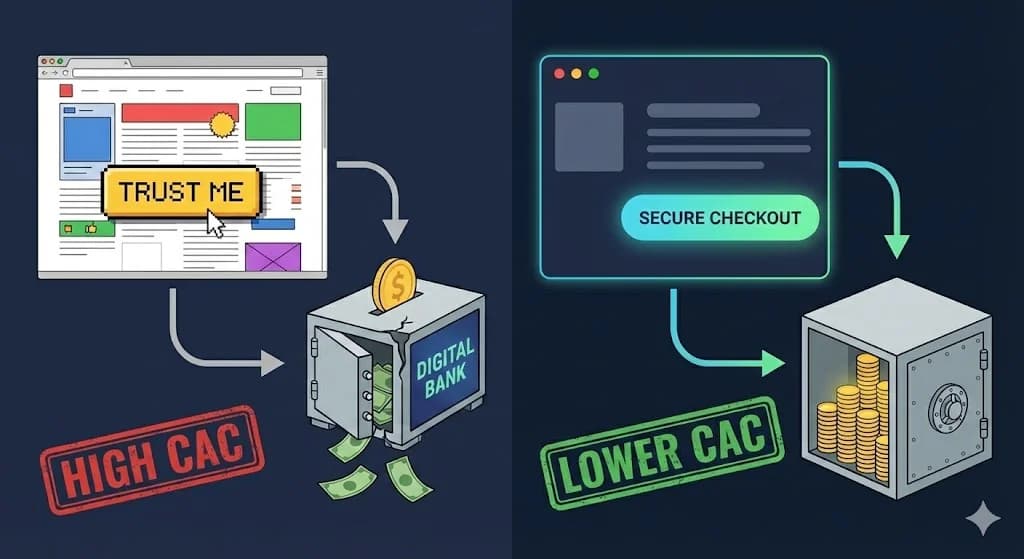
Beauty is a KPI: How Strategic UI Design Lowers Your Customer Acquisition Costs
There is a dangerous misconception in the boardroom: that design is a "nice to have" layer applied after the code is written. In the data-driven landscape of 2026, where competition is just a click away, design is the primary differentiator of trust. It is not art; it is visual economics.
The 50-Millisecond Judgement: The Economics of First Impressions
Studies show users form an opinion about your website's credibility in 0.05 seconds. This is the "Halo Effect." If your typography looks cheap, your layout feels cluttered, or your images are generic, the user subconsciously labels your product as "risky."
The Financial Impact: You just paid $5 for that click via Google Ads. If the user bounces in 3 seconds because of bad UI, you didn't have a traffic problem; you burned capital on a trust problem. High-end design lowers your CAC (Customer Acquisition Cost) by increasing the efficiency of every dollar spent on ads.
Reducing Cognitive Load = Increasing Conversions
Good design is invisible because it creates a frictionless path to value. When we audit client interfaces, we look for "Cognitive Debt"—the mental effort required to use your interface. We fix this by applying:
- Visual Hierarchy: Using size and contrast to guide the eye. If everything is bold, nothing is important.
- Affordance Theory: Buttons must look like buttons. Inputs must look like inputs. Don't make the user guess.
- Law of Proximity: Grouping related elements to reduce mental processing time.
Design Systems as Scalability Tools
Finally, consistency saves money. By implementing a molecular Design System (Figma to Code), we ensure that your developers aren't reinventing the wheel for every new landing page. This speeds up development cycles by 40% and ensures that your brand value remains intact across every touchpoint.
Related Insights
When AI Recommends Tools, Is Yours on the List? The New Digital Positioning Playground
Traditional SEO is changing. We analyze how to structure your web platform and data so that AI models recommend your product.
Read Article →JavaScript Grows Up: Why the ES2026 Specification is a Declaration of War on External Libraries
Ecma International officially approves ECMAScript 2026. We analyze how the language natively absorbs historical challenges in mathematical precision, async streams, and data formatting.
Read Article →