
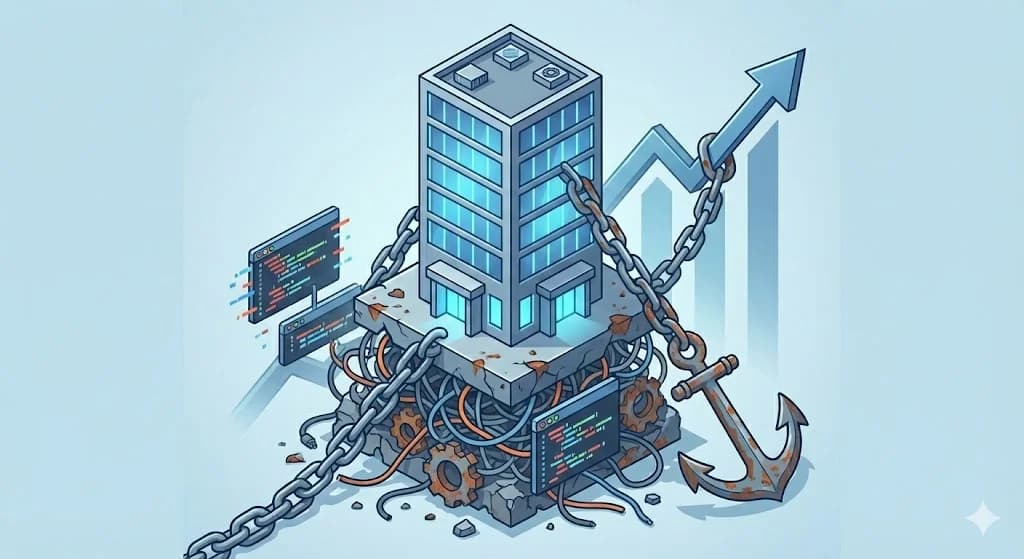
The Ultimate Guide to Technical Debt: How to Stop Today's Code from Mortgaging Tomorrow's Business
In the fast-paced world of software development, the pressure to launch products (Time-to-Market) often forces teams to make quick decisions. These decisions, while necessary in the short term, generate what engineering refers to as Technical Debt. Like financial debt, it isn't intrinsically bad, but if managed poorly—and if the 'interest' isn't paid—it will eventually declare your company technologically bankrupt.
What is Technical Debt Really? Beyond the Metaphor
The term, coined by Ward Cunningham, describes the additional cost of maintenance and development arising from choosing an easy or quick solution instead of a well-designed architecture. In 2026, with systems increasingly integrated and dependent on AI, technical debt no longer affects just code; it impacts data, infrastructure, and security.
Imagine building a house and, to finish sooner, deciding not to lay deep foundations. The house looks good, and you can move in (successful launch). However, when you want to add a second floor (scalability), the structure won't hold. You'll have to spend three times the time and money reinforcing the foundation than if you had done it right from the start.
Types of Technical Debt: Not All 'Mistakes' Are Equal
To manage debt, we first need to identify it. It is often classified in the "Technical Debt Quadrant":
- Reckless and Deliberate: "We don't have time for testing, just ship it." This is the most dangerous type and often sinks startups.
- Prudent and Deliberate: "We know this architecture won't scale to a million users, but we need to validate the product with a thousand today." This is a smart business decision, provided repayment is planned.
- Reckless and Inadvertent: Occurs due to a lack of team experience. It's discovered when the system starts failing for no apparent reason.
- Prudent and Inadvertent: "Now that we've finished, we see how we should have done it." This is a natural part of learning and technological evolution.
The Economic Impact: Why the CEO Should Care About Code
Many executives view refactoring as a 'whim' of programmers. Nothing could be further from the truth. Technical debt has a direct impact on the bottom line:
- Opportunity Cost: While your team spends 70% of their time fixing bugs in old versions, your competitor is launching three new features that are stealing your market share.
- Talent Churn: Top developers want to work in clean, modern environments. Forcing a senior dev to work on obsolete spaghetti code is the fastest way to send them to another company.
- Security Risk: Poorly structured code is harder to audit. Security holes often hide in those "quick fixes" that no one documented.
How to Manage and Pay Down Debt: An Action Plan
At our agency, we don't believe in halting development to "clean code." We believe in a sustainable repayment strategy:
1. The 20% Budget
We recommend dedicating 20% of every development cycle (sprint) to maintenance tasks, library updates, and refactoring. This keeps debt interest under control without stopping value delivery.
2. Visibility and Debt Registry
What isn't measured isn't managed. It is vital to have a "Technical Debt Backlog" where developers flag areas of the software needing improvement. This allows the product team to prioritize these tasks when working on specific modules.
3. Automation as Life Insurance
Implementing CI/CD (Continuous Integration and Deployment) and automated unit testing ensures that, when attempting to pay down debt, we aren't creating new problems. A system without tests is a system that cannot be refactored safely.
Related Insights
When AI Recommends Tools, Is Yours on the List? The New Digital Positioning Playground
Traditional SEO is changing. We analyze how to structure your web platform and data so that AI models recommend your product.
Read Article →JavaScript Grows Up: Why the ES2026 Specification is a Declaration of War on External Libraries
Ecma International officially approves ECMAScript 2026. We analyze how the language natively absorbs historical challenges in mathematical precision, async streams, and data formatting.
Read Article →