
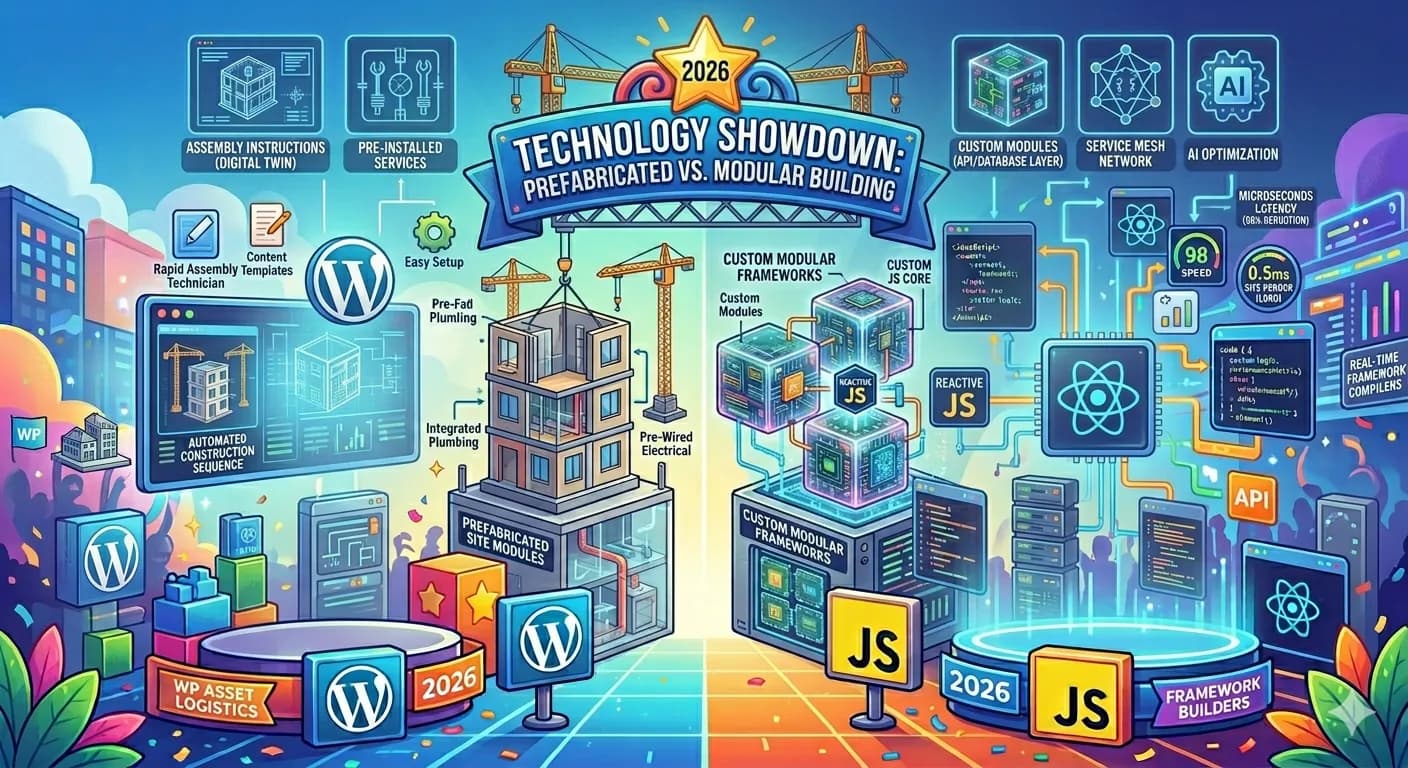
The Technical Choice Paradox: WordPress vs. Custom Architectures in 2026
In today’s technological landscape, the decision between adopting a pre-packaged ecosystem like WordPress or investing in a custom JavaScript architecture (React, Next.js, Node.js) has moved past simple budgeting—it’s now about digital sovereignty.
At Empirical Studio, we frequently encounter companies trapped under the "glass ceiling" of traditional CMS platforms. What began as a quick fix eventually becomes an operational burden. Let’s analyze why the architecture you choose today determines your ability to innovate tomorrow.
The Security Lifecycle: From Patching to Immunity
WordPress operates on a shared security model. Being the engine for 40% of the web means any vulnerability in a popular plugin becomes a global crisis. IT teams are forced into a reactive stance: update, patch, and pray that the core update doesn't break sales system compatibility.
Custom JS development changes the paradigm. By building your own backend, the attack surface is drastically reduced. There is no standard /wp-admin route for bots to target. Security is built-in (Security by Design), allowing for modern authentication protocols and data encryption tailored to your specific business flow, without relying on the code hygiene of an external plugin developer.
Performance: The Hidden Cost of Abstraction
WordPress is, by definition, general-purpose software. This means every time a user loads your page, the server processes thousands of lines of code your site doesn’t actually need. SEO plugins, caching, forms... each adds a layer of latency.
In modern framework development, we apply the Selective Loading principle. Using techniques like Server-Side Rendering (SSR) and Static Site Generation (SSG), we deliver only the strictly necessary HTML and JS to the browser. In 2026, where search algorithms penalize every millisecond of delay, this efficiency is a direct competitive advantage affecting your Customer Acquisition Cost (CAC).
Maintenance vs. Evolution
There is a myth that WordPress requires no technical maintenance. In reality, it requires fragmented maintenance. Moving from version 6.x to 7.x can take days of auditing to ensure the plugin ecosystem doesn't collapse.
With custom development, maintenance is a controlled evolution. Having your own backend allows you to integrate AI services, connect with logistics APIs, or change payment gateways without fear of unforeseen side effects. You have total control over the data schema, which significantly eases scalability and future integrations with native mobile apps.
"If your business relies on a unique process that sets you apart from the competition, don't try to squeeze it into a tool designed to be the same for everyone."
Conclusion: Where is your investment going?
WordPress is the perfect tool for validating a market (MVP) or managing pure editorial content. But if your goal is to build a platform that supports growth, user security, and a top-tier user experience, custom development is the only path to technical excellence.
At Empirical Studio, we design architectures that don't expire. We don't just install solutions; we build the foundations of your digital success.
Related Insights
When AI Recommends Tools, Is Yours on the List? The New Digital Positioning Playground
Traditional SEO is changing. We analyze how to structure your web platform and data so that AI models recommend your product.
Read Article →JavaScript Grows Up: Why the ES2026 Specification is a Declaration of War on External Libraries
Ecma International officially approves ECMAScript 2026. We analyze how the language natively absorbs historical challenges in mathematical precision, async streams, and data formatting.
Read Article →