
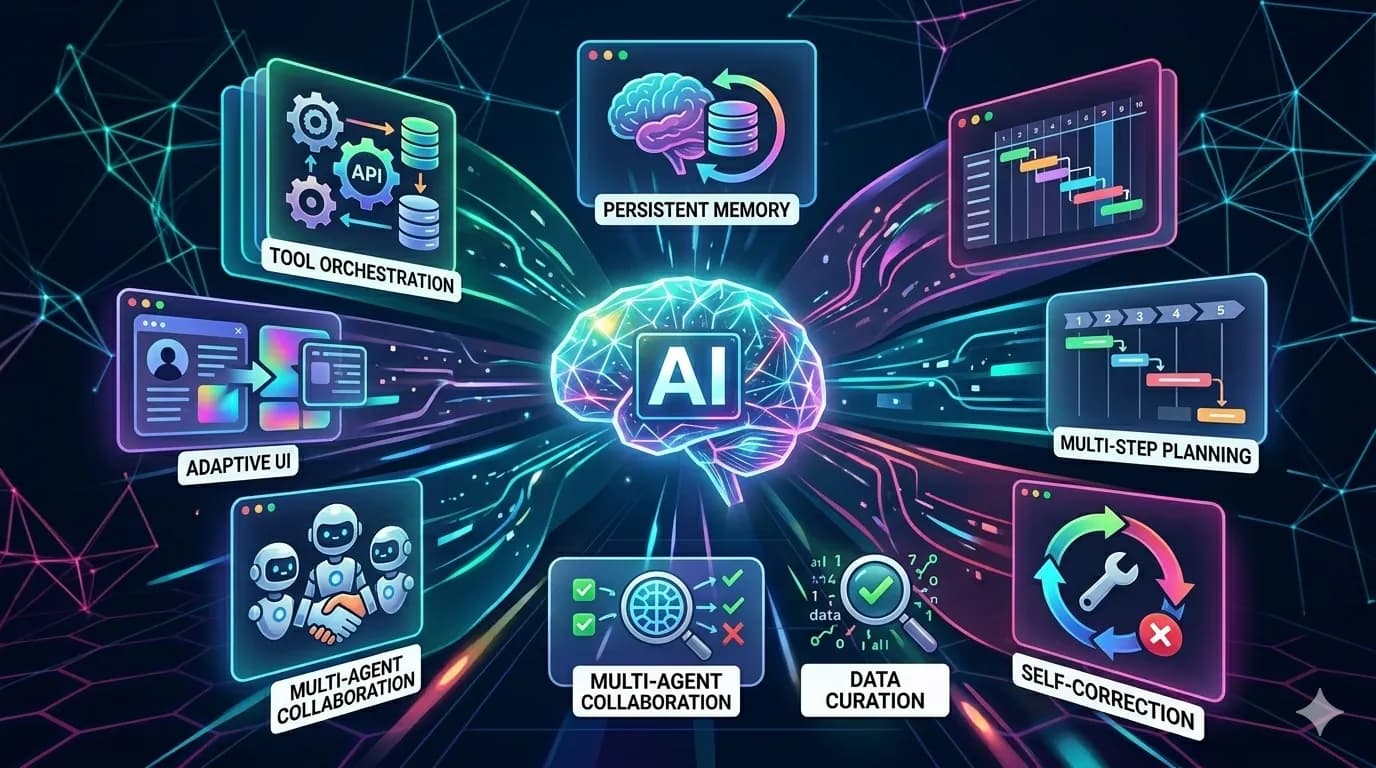
The New Executive Layer: 7 'Skills' Defining Leading Software in 2026
During the AI explosion of 2024, the market was flooded with chat wrappers. Today, in 2026, that model has collapsed. Customers are no longer looking for an AI that gives them advice; they are looking for **software that solves problems from start to finish**.
At Empirical Studio, we define this evolution as the shift from 'Generative AI' to 'Executive AI'. For your product to be relevant this year, it must stop being a hammer the user strikes and start behaving like a craftsman who knows the trade.
1. Orchestration and the End of 'Data Islands'
The first big leap is Tool Use. Modern software doesn't just tell you sales are down; an AI agent detects the dip, accesses your CRM, analyzes the latest marketing campaign, and automatically generates a comparative report. The ability to invoke APIs and handle external tools is what takes AI out of the chat and into real operations.
2. Long-Term Memory (Infinite Context)
The great failure of traditional software is its amnesia. In 2026, we implement architectures that allow AI to remember not just the current session, but historical preferences and workflows from months ago. If a user prefers certain report formats or has specific biases in their decision-making, the software proactively adapts.
3. Cascade Reasoning: From command to plan
Faced with a complex instruction like "Prepare the company for the May audit," the software no longer stalls. It uses Chain-of-Thought reasoning to break that goal down into 50 subtasks, assign priorities, and begin executing purely digital ones (collecting invoices, verifying signatures) while preparing a pending summary for the human.
"True innovation isn't AI writing a poem; it's understanding the mess of your processes and creating a logical structure to fix them."
4. Operational Resilience: The system that doesn't quit
Historically, if an integration failed, the software threw a 404 error and stopped. Today's agents have Self-Healing capabilities. If a translation service is down, the agent finds a real-time alternative or rethinks the task to keep the business flow moving. It's software that solves its own technical problems.
5. Cognitive Curation Against the Noise
We are flooded with artificially generated data. Skill number 5 is the software's ability to act as a quality filter. The system must audit data veracity, detect hallucinations, and present only the data with a direct impact on ROI, saving the user hours of data cleaning.
6. Multi-Agent Systems (MAS): The Digital Office
The future isn't one AI model doing everything. It's an architecture where an 'Architect' agent directs 'Specialist' agents. Imagine a flow where a security agent audits code while a design agent generates the interface and a third verifies accessibility. This collaboration reduces development times by 70%.
7. Mutating Interfaces (Generative UI)
Finally, design is no longer static. Software must have the skill to **reconfigure its own interface** based on the moment's need. If the agent detects you are in 'Crisis Analysis' mode, the screen will hide distractions and highlight critical KPIs and urgent communication channels.
Is your product a tool or a strategic partner?
At Empirical Studio, we don't build simple applications; we design autonomous ecosystems. If you want your software to stop being a maintenance expense and become your most productive asset, let's talk about implementing these 7 pillars in your roadmap.
Related Insights
When AI Recommends Tools, Is Yours on the List? The New Digital Positioning Playground
Traditional SEO is changing. We analyze how to structure your web platform and data so that AI models recommend your product.
Read Article →JavaScript Grows Up: Why the ES2026 Specification is a Declaration of War on External Libraries
Ecma International officially approves ECMAScript 2026. We analyze how the language natively absorbs historical challenges in mathematical precision, async streams, and data formatting.
Read Article →