
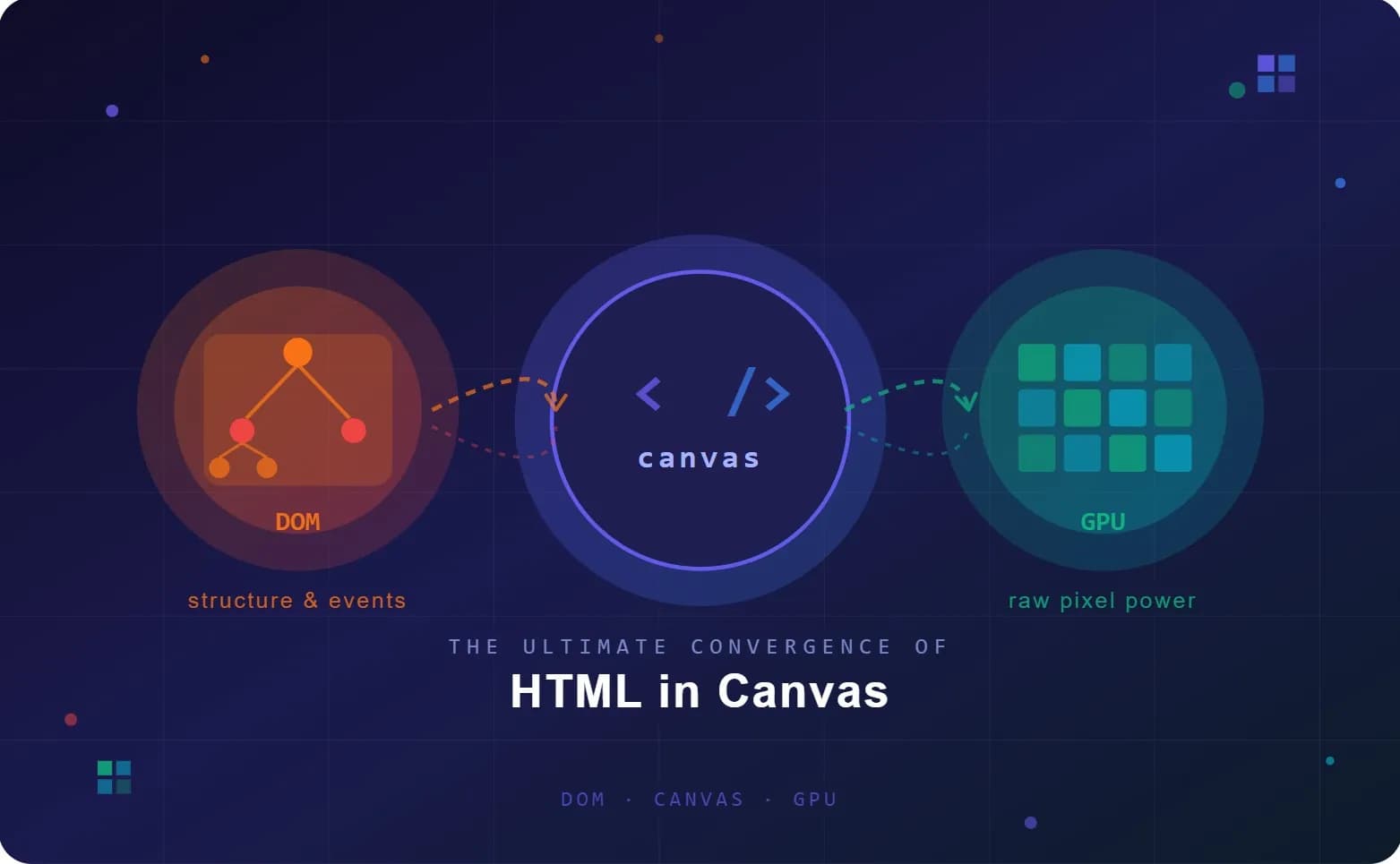
HTML in Canvas: The Ultimate Convergence of DOM and GPU
For years, web developers have lived with a frustrating compromise: use the DOM for flexible, accessible interfaces, or use Canvas for high-performance graphics. Attempting to make these two worlds communicate was inefficient. The HTML in Canvas proposal from the WICG changes the rules of the game.
At Empirical Studio, we break down why this is the most significant technical leap of the decade for browser-based software.
The Technical Challenge: The 'Pixel Wall'
Until now, the <canvas> element was a "black box". Anything drawn inside using WebGL or WebGPU was invisible to screen readers and SEO. If you wanted an interactive button in a 3D environment, you had to manually code every state, which was error-prone and costly.
The Solution: Accessibility Subtrees and Direct GPU Rendering
The new specification allows for a subtree of HTML elements to reside within the Canvas with immediate benefits:
- Native Rasterization: The browser draws HTML directly into the Canvas's GPU buffer.
- Thread Efficiency: Layout doesn't block the main thread, allowing for fluidity up to 144Hz.
- Native Accessibility: By using semantic elements, the Accessibility Object Model (AOM) recognizes them automatically.
"We aren't just projecting images of buttons; we are allowing the DOM to live and breathe within the silicon of the graphics card."
Impact on Product Development
1. Seamless UI Experiences
Imagine a video editing suite where controls are pure HTML but are affected by real-time lighting and shadows from the 3D scene. We can now apply CSS filters that interact with the Canvas's depth buffer (Z-buffer).
2. Massive Data Visualization
At Empirical, we handle large datasets. With this technology, we can render 100,000 points via WebGPU, each with a native HTML tooltip and complex styling, without any frame drops.
Performance Benchmark (2026 Forecast)
| Method | CPU Overhead | Input Latency | Accessibility |
|---|---|---|---|
| DOM Overlay (Traditional) | High (Constant Sync) | Medium | Excellent |
| Simulated Canvas UI | Medium | Low | None / Manual |
| HTML in Canvas (WICG) | Minimal (GPU-bound) | Ultra-Low | Native |
The future of the web is immersive and accelerated.
At Empirical Studio, we are ready to implement these experimental APIs in products requiring peak performance. Is your architecture ready for the leap?
Related Insights
When AI Recommends Tools, Is Yours on the List? The New Digital Positioning Playground
Traditional SEO is changing. We analyze how to structure your web platform and data so that AI models recommend your product.
Read Article →JavaScript Grows Up: Why the ES2026 Specification is a Declaration of War on External Libraries
Ecma International officially approves ECMAScript 2026. We analyze how the language natively absorbs historical challenges in mathematical precision, async streams, and data formatting.
Read Article →