
AI Agents: Why 2026 is the Year Software Stopped Being a Tool and Became an Employee
For the last two years, we've treated AI as an assistant: we ask, it answers. At Empirical Studio, we're witnessing a new era: the age of AI Agents.
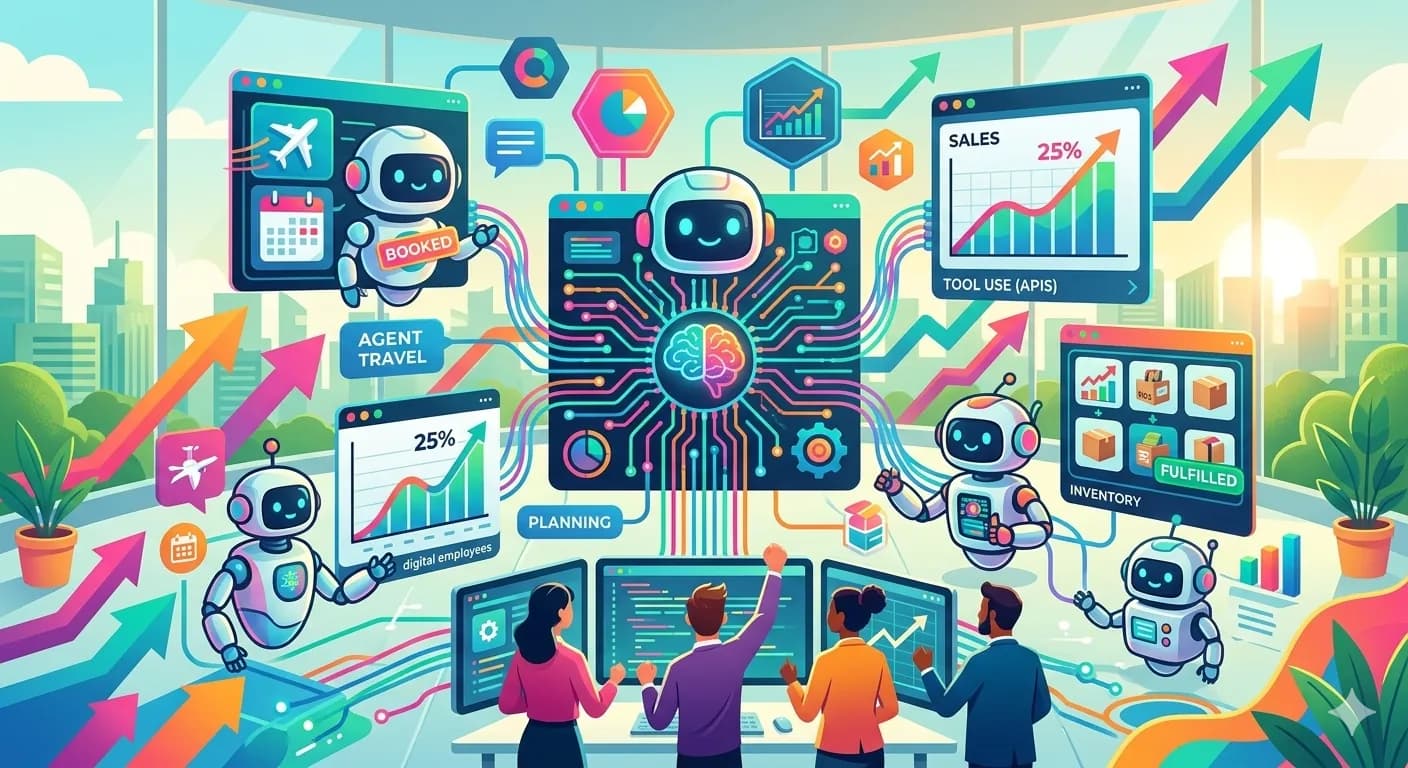
Unlike traditional chatbots, an agent doesn't wait for step-by-step instructions. It has a goal, access to tools (Skills), and the reasoning ability to complete complex tasks autonomously. **Software has evolved from being a hammer to being the craftsman.**
What Makes an Agent "Autonomous"?
In 2026, an agent must fulfill the **P-R-A cycle (Perception, Reasoning, and Action)**. It doesn't just process text; it interacts with the real world through deep integrations.
"A chatbot tells you how to plan a trip. An AI agent books the flights, manages cancellations, and syncs the itinerary to your calendar without you lifting a finger."
The 4 Critical Components of an Agent
- Memory: Short and long-term memory to learn from past interactions and user preferences.
- Tool Use: The ability to call APIs and databases to perform real actions.
- Planning: Breaking down big goals into logical, executable sub-tasks.
- Self-Correction: Analyzing failures and finding alternative paths to reach the goal.
The Real ROI: Use Cases
We are seeing massive returns in departments like Customer Support (60% faster resolution), Sales (25% higher conversion), and Operations (98% reduction in manual errors).
Is your infrastructure ready for the digital workforce?
At Empirical Studio, we build the agents that drive your operations. It's time to stop asking and start executing.
Related Insights
When AI Recommends Tools, Is Yours on the List? The New Digital Positioning Playground
Traditional SEO is changing. We analyze how to structure your web platform and data so that AI models recommend your product.
Read Article →JavaScript Grows Up: Why the ES2026 Specification is a Declaration of War on External Libraries
Ecma International officially approves ECMAScript 2026. We analyze how the language natively absorbs historical challenges in mathematical precision, async streams, and data formatting.
Read Article →