
AI Isn't Magic, It's Engineering: How to Implement LLMs Without Leaking Private Data
The Artificial Intelligence 'Hype' cycle has passed. No one is impressed anymore because a chatbot wrote a poem. Now, executives are asking the million-dollar question: "How does this make my company more efficient and profitable?". The answer isn't in knowing how to write 'prompts', but in data engineering.
The "Black Box" Problem and Hallucination
If you ask a generic AI about stock in your warehouse, it will make it up (hallucinate) because it doesn't have your data. If you copy-paste your data into it, you are violating privacy regulations (GDPR).
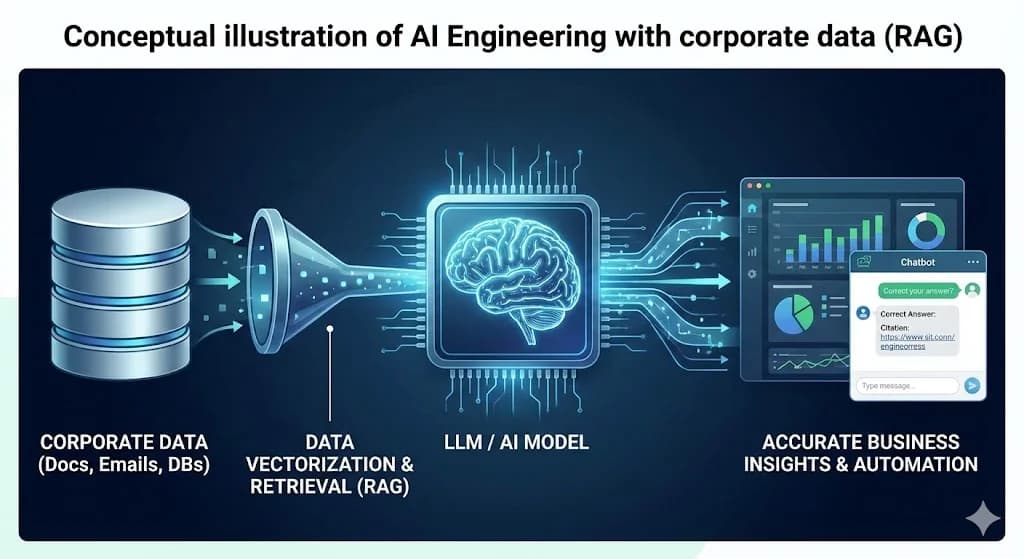
The corporate solution is called RAG (Retrieval-Augmented Generation).
How Does a RAG Architecture Work?
- Vectorization: We take your manuals, historical emails, or databases and convert them into numbers (embeddings) in a vector database.
- Retrieval: When an employee or client asks something, the system first searches for relevant information in YOUR database.
- Generation: We send the question + only the retrieved information to the AI. The AI acts as a writer, not an encyclopedia.
Result: Answers 100% based on your real data, with citations to the source and no fabrications.
Real Use Cases We Are Implementing
- Employee Onboarding: An assistant that answers HR questions ("How do I request time off?") by reading internal PDFs.
- Level 1 Tech Support: Automation of complex responses based on the history of previously resolved tickets.
- Contract Analysis: Automatic extraction of risk clauses in massive legal documents.
Related Insights
When AI Recommends Tools, Is Yours on the List? The New Digital Positioning Playground
Traditional SEO is changing. We analyze how to structure your web platform and data so that AI models recommend your product.
Read Article →JavaScript Grows Up: Why the ES2026 Specification is a Declaration of War on External Libraries
Ecma International officially approves ECMAScript 2026. We analyze how the language natively absorbs historical challenges in mathematical precision, async streams, and data formatting.
Read Article →