
Decoupling the Monolith: Why Headless Architecture is Your Content's Life Insurance
For the last decade, the web operated under the "Monolith" model: a single software (like classic WordPress or Drupal) controlled everything, from the database to the HTML the user sees. It was easy, yes. But in 2026, it's a security risk and an innovation bottleneck.
What is Headless and Why is Everyone Migrating There?
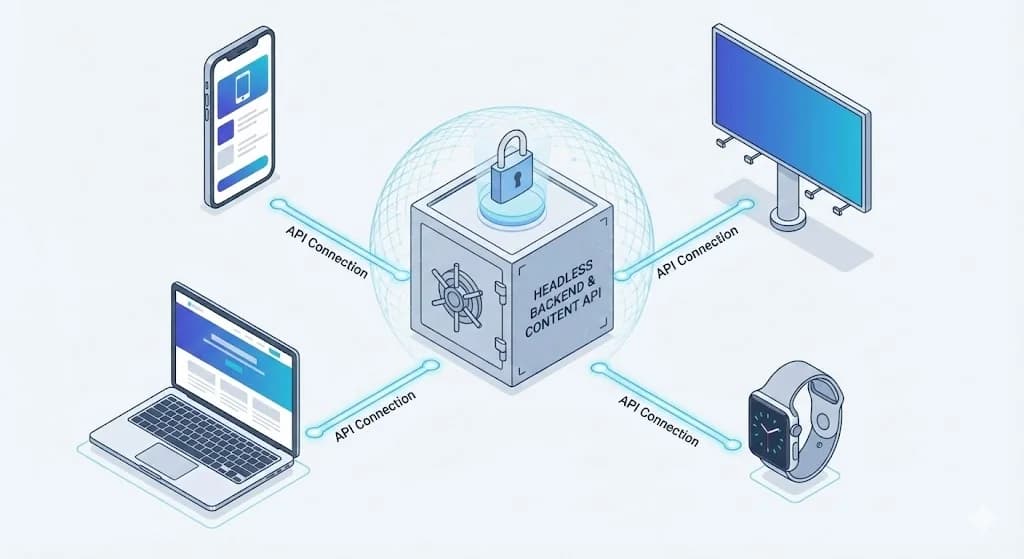
Imagine cutting the "head" (the frontend, what is seen) off the "body" (the backend, where data is kept). Now, instead of being glued together, they communicate via API.
This means your content lives in a pure central repository (Contentful, Strapi, Sanity) and can be sent anywhere: to your Next.js website, your mobile App, a smartwatch, or a screen in your physical store.
Security by Design
90% of hacks on corporate websites occur due to vulnerabilities in plugins or SQL injections in exposed databases.
In a Headless architecture (often called Jamstack):
- Reduced Attack Surface: The frontend is just pre-generated static files. There is no database to attack when visiting the web.
- Decoupling: If your site goes down due to a traffic spike, your backend (where you edit) stays alive. If they attack your backend, your site remains online serving the cached version.
Real Omnichannel: COPE (Create Once, Publish Everywhere)
Companies waste thousands of hours copy-pasting the same text for the web, the app, and the mailing list. With a Headless CMS, you create the product "Sneakers X" once. The web takes the long description, the app takes the summary, and the smartwatch takes the price. It is efficiency taken to the extreme.
Related Insights
When AI Recommends Tools, Is Yours on the List? The New Digital Positioning Playground
Traditional SEO is changing. We analyze how to structure your web platform and data so that AI models recommend your product.
Read Article →JavaScript Grows Up: Why the ES2026 Specification is a Declaration of War on External Libraries
Ecma International officially approves ECMAScript 2026. We analyze how the language natively absorbs historical challenges in mathematical precision, async streams, and data formatting.
Read Article →