
Are MCPs Dying? The Debate Between Context and Execution (Skills) in the Agent Era
In the 2026 AI ecosystem, things move fast. Just months ago, the Model Context Protocol (MCP) seemed like the ultimate solution for connecting LLMs with external data. Today, the rise of Skills (direct execution capabilities) has led many to declare the death of MCP. But is it a replacement or an evolution?
At Empirical Studio, we are building complex AI agents and have learned that this debate stems from a fundamental confusion between information access and action capability.
What Is Each One? Breaking Down the Concepts
MCP: The Universal Context Translator
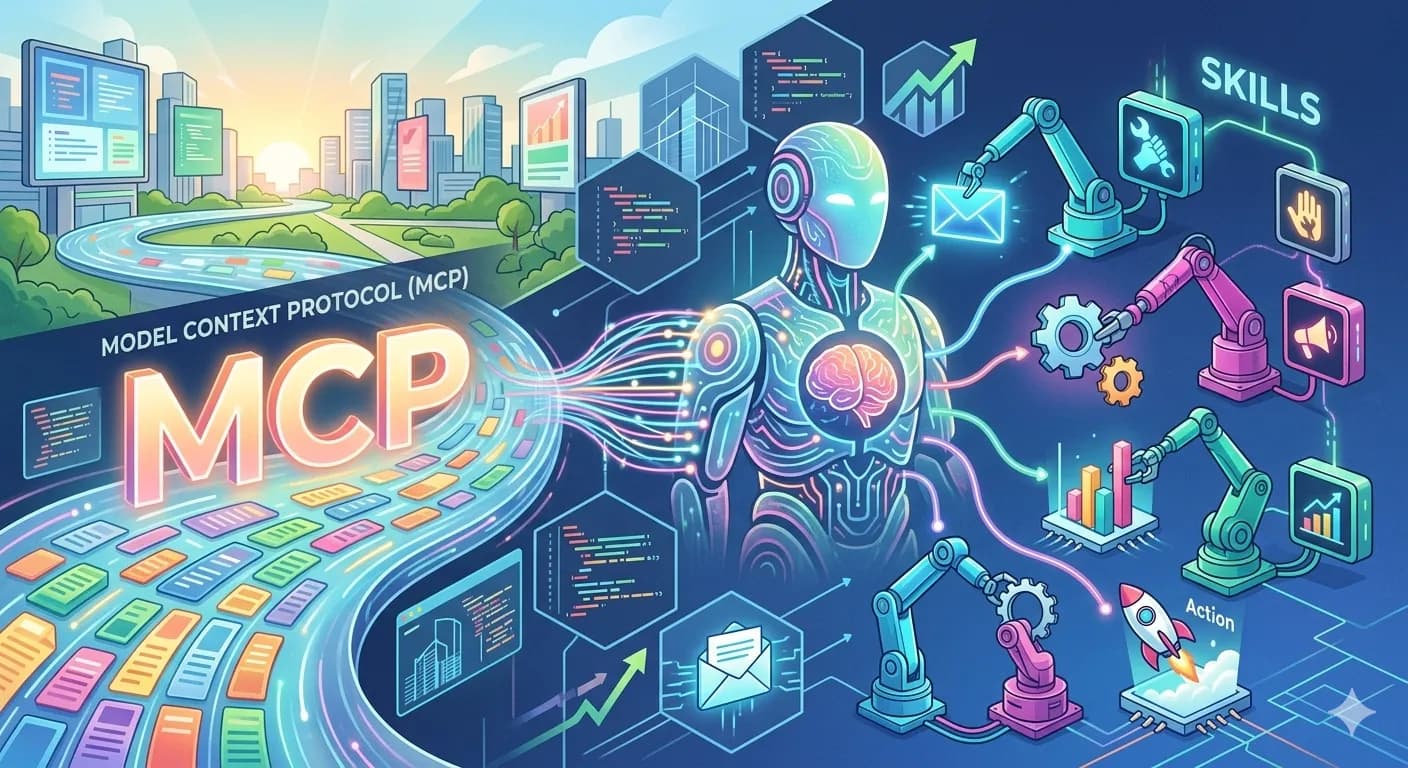
MCP is not an execution tool; it's a communication standard. Think of it as the USB-C port for LLMs. It allows a model to "see" and "understand" the structure of a database, a GitHub repo, or a CRM in a standardized way.
Skills: The Agent's "Hands"
Skills are specific, atomic functions that the AI can invoke to perform a task: "Send this email," "Restart the server," or "Generate invoice." They are direct, fast, and designed for pure action.
Why Skills Won't Kill MCP
The rumor of MCP's death comes from the simplicity of Skills. It's easier to program a Skill than to implement a full MCP server. However, for enterprise-grade AI agents, Skills have a ceiling: they lack deep context.
"A Skill can send an email, but MCP is what tells the AI the entire previous history with that client so the email actually makes sense."
Conclusion? If you are building a simple integration, Skills are your best ally for speed. But if your goal is an agent ecosystem that understands your business holistically, MCP remains the indispensable infrastructure.
Related Insights
When AI Recommends Tools, Is Yours on the List? The New Digital Positioning Playground
Traditional SEO is changing. We analyze how to structure your web platform and data so that AI models recommend your product.
Read Article →JavaScript Grows Up: Why the ES2026 Specification is a Declaration of War on External Libraries
Ecma International officially approves ECMAScript 2026. We analyze how the language natively absorbs historical challenges in mathematical precision, async streams, and data formatting.
Read Article →