
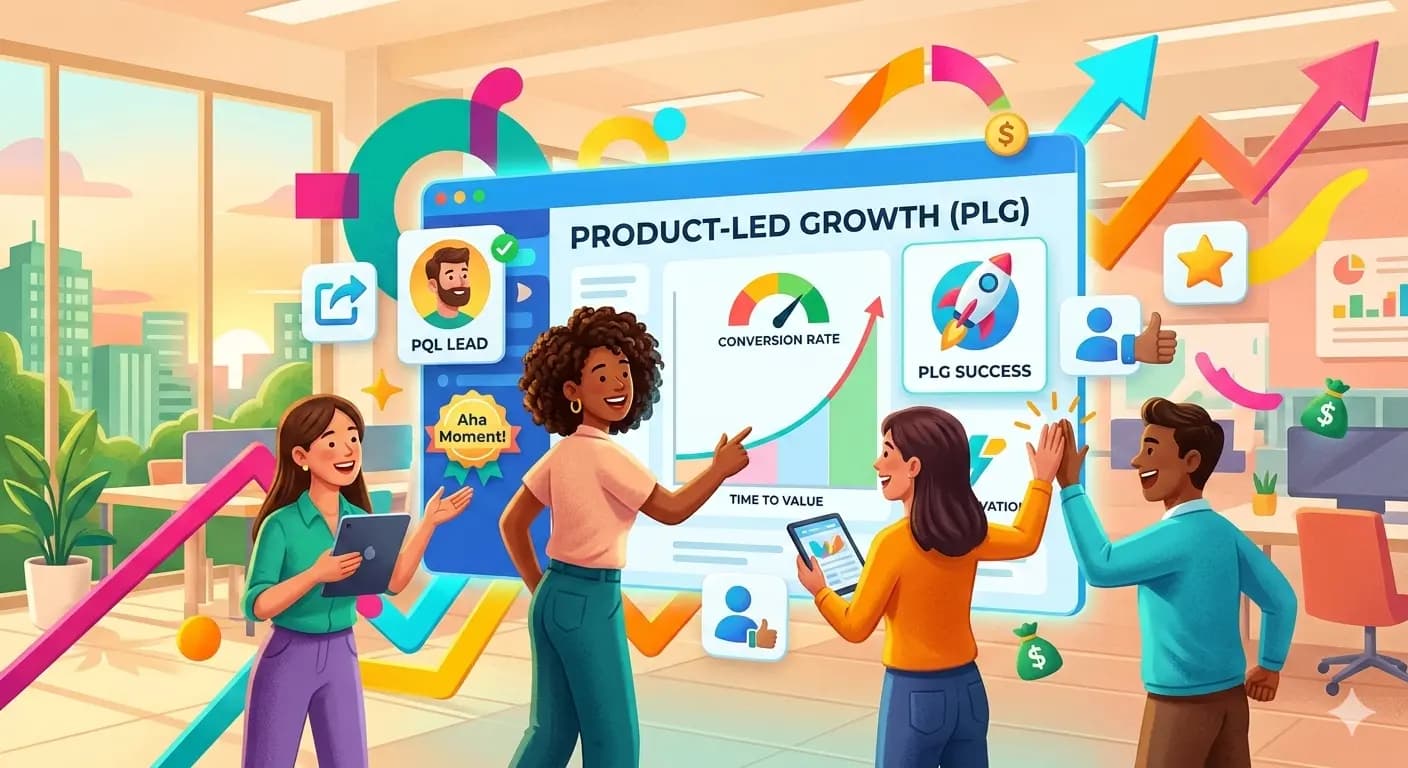
Product-Led Growth (PLG): Why Your Software Should Be Your Best Salesman
For decades, B2B software was sold on golf courses and through PowerPoint presentations. The process was slow, expensive, and relied on the persistence of a sales team. But in 2026, the paradigm has completely shifted: the modern buyer has a "friction allergy."
At Empirical Studio, we've observed that companies trying to force a traditional sales process for digital products are losing to more agile competitors applying Product-Led Growth (PLG). It's not just a trend; it's a matter of economic efficiency.
The End of the "Demo Gatekeeper"
How many times have you abandoned a website because you were forced to fill out a form to "book a demo"? That's the Sales-Led model, and it's dying. Today's user wants to touch, test, and break the software before talking to a human.
"If your software needs a salesperson to explain why it's valuable, you have a design problem, not a sales problem."
The 3 Pillars of PLG We Implement
- Instant "Aha Moment": The time it takes for a user to perceive the product's real value must be under 5 minutes.
- Self-service Onboarding: We design flows where the user learns to use the tool while using it, eliminating the need for PDF manuals or training videos.
- Viral Expansion: If your tool allows for collaboration, every new invited user is a free lead entering your ecosystem.
Metrics That Matter (And They Aren't Just Traffic)
When the software is your salesperson, the success dashboard changes. We no longer look just at visits, but at usage health:
| Traditional Metric | PLG Metric (Empirical Focus) |
|---|---|
| MQL (Marketing Qualified Lead) | PQL (Product Qualified Lead): Users who have already used core features. |
| Cost Per Click (CPC) | Time to Value (TTV): How long does it take for the software to be useful? |
| Web Conversion Rate | Activation Rate: % of users who complete the critical flow. |
Experience Debt: The Scaling Killer
Many CEOs wonder why their CAC (Customer Acquisition Cost) is constantly rising. The answer is usually technical friction. Every bug in registration or every unnecessary step in configuration is a barrier your sales team has to "push" through with calls and emails. That doesn't scale.
In modern development, optimizing a checkout flow or simplifying an API integration is, literally, a sales action. At Empirical, we treat every line of code as part of the conversion funnel.
Conclusion? In 2026, growth doesn't come from shouting louder on LinkedIn, but from building a product so intuitive that the user feels "foolish" for not paying for the subscription.
Is your product working for you, or are you working to compensate for your product's shortcomings?
Related Insights
When AI Recommends Tools, Is Yours on the List? The New Digital Positioning Playground
Traditional SEO is changing. We analyze how to structure your web platform and data so that AI models recommend your product.
Read Article →JavaScript Grows Up: Why the ES2026 Specification is a Declaration of War on External Libraries
Ecma International officially approves ECMAScript 2026. We analyze how the language natively absorbs historical challenges in mathematical precision, async streams, and data formatting.
Read Article →