
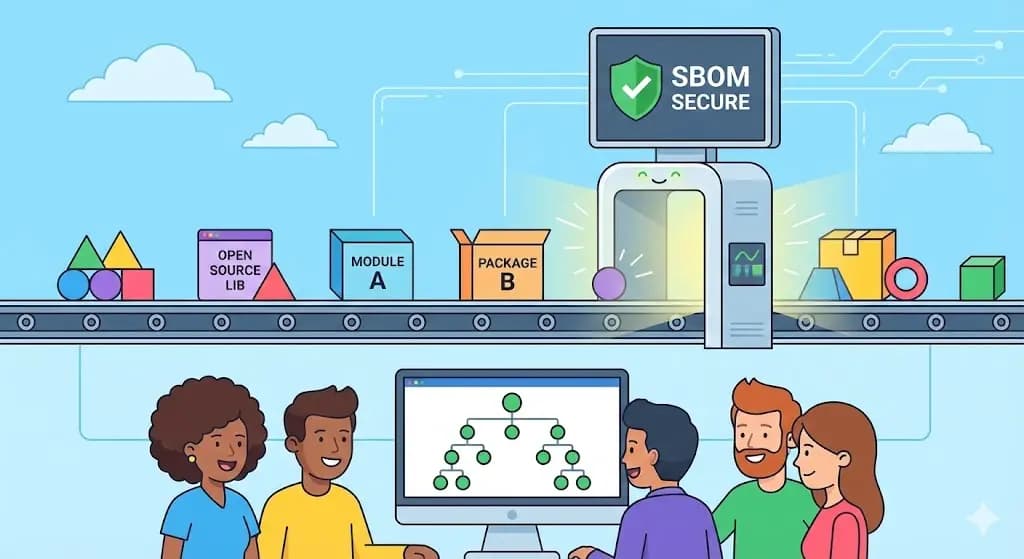
The 97% You Didn't Write: Why Software Supply Chain Attacks Are Your CEO's New Nightmare
Here is a terrifying statistic: In 2026, 97% of the code in a modern web application is Open Source dependencies. Your developers only write the remaining 3% that glues it all together. When you deploy your app, you aren't just deploying your work; you are deploying the work of thousands of strangers who maintain libraries like React, Lodash, or Axios.
The "NPM Install" Lottery
Every time a developer runs npm install, they are pulling code into your core infrastructure. Attackers have realized that hacking your firewall is hard, but hacking a small, unmaintained library that you use is easy. This is a Supply Chain Attack.
The most famous example was Log4j, but it happens daily. An attacker compromises a popular package, injects a backdoor, and suddenly, thousands of Fortune 500 companies unknowingly update to the malicious version.
The Solution: The SBOM (Software Bill of Materials)
You wouldn't buy a car without a list of parts. Why do you accept software without knowing what's inside?
The new industry standard is the SBOM. It is a formal inventory of every component, library, and module that makes up your software. It allows you to answer the critical question: "A new vulnerability was just found in Library X... are we using it?". Without an SBOM, answering that takes weeks. With one, it takes seconds.
DevSecOps: Moving Security to the Left
Waiting for a security audit right before launch is suicide. We implement "Shift Left" Security:
- Automated Scanning: Our CI/CD pipelines block any code merge if it introduces a dependency with known vulnerabilities.
- Dependency Locking: We freeze versions to prevent "updates" from sneaking in unverified code.
- Private Registries: For enterprise clients, we create a firewall between their code and the public internet registries.
Security is no longer about strong passwords; it's about knowing exactly what ingredients are in your digital recipe.
Related Insights
When AI Recommends Tools, Is Yours on the List? The New Digital Positioning Playground
Traditional SEO is changing. We analyze how to structure your web platform and data so that AI models recommend your product.
Read Article →JavaScript Grows Up: Why the ES2026 Specification is a Declaration of War on External Libraries
Ecma International officially approves ECMAScript 2026. We analyze how the language natively absorbs historical challenges in mathematical precision, async streams, and data formatting.
Read Article →