
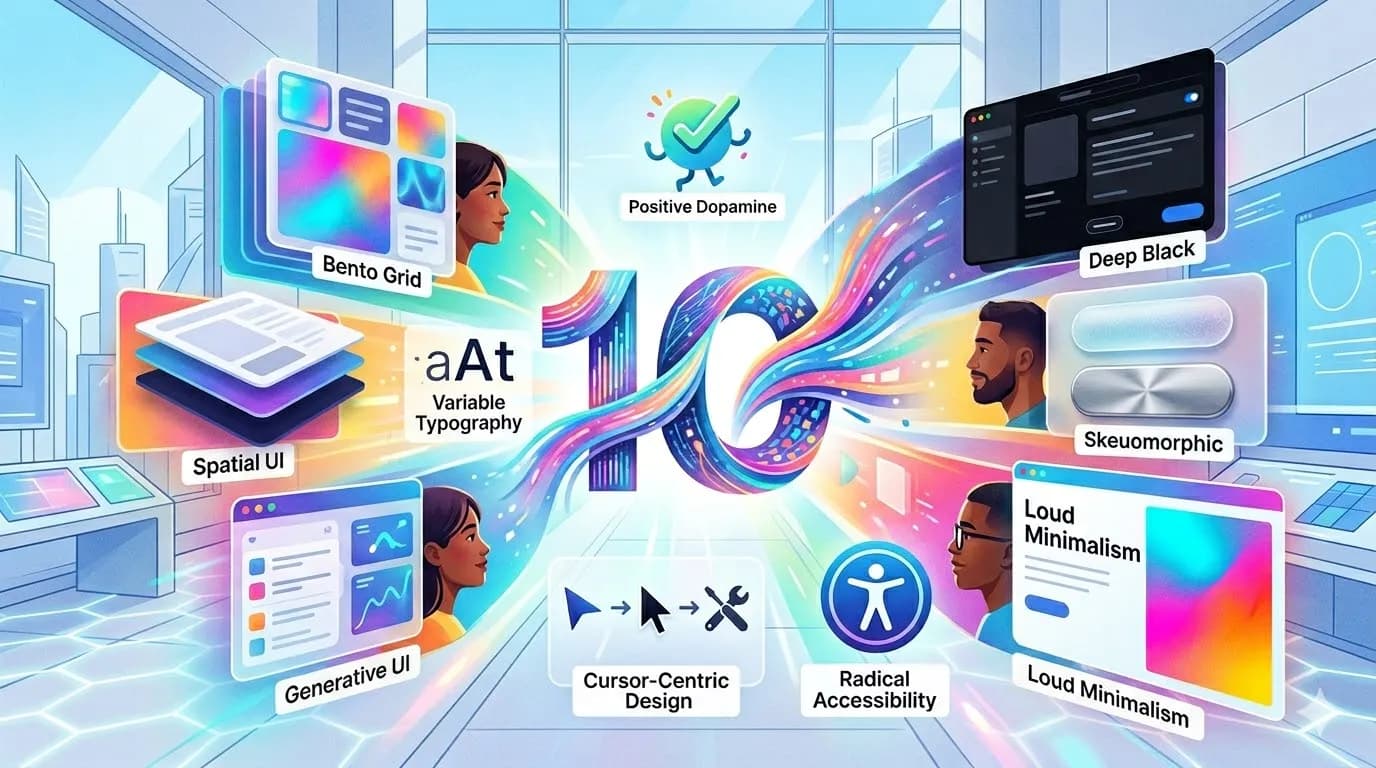
The 2026 Visual Manifesto: 10 Trends Redefining Software Design
Software design in 2026 is no longer a superficial layer of "aesthetics"; it's the interface of trust. In a saturated market, true differentiation lies not in functionality, but in how the product feels and behaves in response to user intent.
At Empirical Studio, we've synthesized the 10 currents setting the pace this year, where engineering and psychology join forces to solve real retention and conversion problems.
1. Bento Grids 2.0 (Smart Modular Hierarchy)
The Bento Grid has evolved from a static grid to a system of smart cells. Thanks to advanced CSS Container Queries, modules no longer just adapt to screen width, but to the space available in their container. This allows a complex dashboard to reorder dynamically: a metrics cell can expand to reveal details without the user losing the context of the rest of the page.
2. Spatial UI and Dynamic Depth (Z-Axis)
Inherited from mixed reality, web software now understands depth. It's not just about shadows; it's about creating a cognitive hierarchy. Shadows in 2026 are dynamic: their diffusion and angle change according to cursor movement, creating a real sense of "floating" that subconsciously indicates which elements are actionable and which are merely informational.
3. Variable Typography and Adaptive Readability
Typography is "alive." We use Variable Fonts that allow weight, width, and optical axis adjustments in real-time. If the software detects (via sensors) that the user is in a high-light environment, it automatically increases font weight to maximize contrast. It's the end of unreadable text on mobile devices under the sun.
4. "Positive Dopamine" Micro-interactions
Behavioral design seeks to retain users through small visual rewards. A "Submit" button that elastically transforms into a checkmark after successful validation generates subtle but addictive satisfaction. At Empirical, we combine this with Haptic Design (subtle vibrations on mobile) to make software feel like a real physical tool.
"In 2026, aesthetics is a function. If it doesn't guide the user or reinforce the workflow, it's simply visual noise."
5. "Deep Black" Dark Mode (OLED Optimization)
Dark mode has evolved to pure black (#000000). This has a dual impact: aesthetic (infinite contrast with neon colors) and technical. On OLED screens, black pixels are off, reducing battery consumption by up to 20%. It's the perfect intersection between cutting-edge design and Green Computing.
6. Modern Skeuomorphism (Soft UI and Textures)
After years of flat, abstract minimalism, users are looking for tangibility. Modern skeuomorphism mimics physical materials like frosted glass (glassmorphism) or elastic surfaces. Buttons have volume and texture again, improving affordance: users instinctively know where to click without needing help labels.
7. Generative UI (AI-Created Interfaces)
The interface is no longer a static file. AI modulates the UI in real-time: a technical profile will automatically see more data tables and logs, while an executive profile will see high-level charts. Software generates the optimal layout based on historical user behavior, drastically reducing the learning curve.
8. Cursor-Centric Design (Pointer as a Tool)
On desktop, the cursor is the center of the experience. The pointer is no longer just an arrow; it changes shape and function according to context. Hovering over a video turns it into a "Play" button, and hovering over long text makes it act as a smart highlighter. It's about bringing UX to the exact point where user attention resides.
9. Radical Accessibility (Native Inclusion)
Accessibility has moved from a final audit to the engine of design. 2026 interfaces are natively prepared for voice and iris navigation. This not only helps people with disabilities but also optimizes the product for multitasking users, expanding any startup's potential market by 15%.
10. "Loud" Minimalism and Vibrant Color
2026 minimalism isn't boring. Clean, hierarchical structures and white space are combined with complex mesh gradients and colors that seem to emit their own light. It's a style that seeks immediate emotional impact, breaking corporate gray monotony to create memorable brands.
Is your software stuck in 2022 or designed for 2026? At Empirical Studio, we transform these trends into competitive advantages. We don't just design screens; we choreograph the future of your product.
Related Insights
When AI Recommends Tools, Is Yours on the List? The New Digital Positioning Playground
Traditional SEO is changing. We analyze how to structure your web platform and data so that AI models recommend your product.
Read Article →JavaScript Grows Up: Why the ES2026 Specification is a Declaration of War on External Libraries
Ecma International officially approves ECMAScript 2026. We analyze how the language natively absorbs historical challenges in mathematical precision, async streams, and data formatting.
Read Article →